

Here’s more than you ever wanted to know about using a spool and a crochet hook to knit a little something.
Spool knitting, corking, French knitting or tomboy knitting uses a spool with nails around the rim to produce a narrow tube of fabric. The devices are called knitting spools, knitting nancys, or French knitters.
The technique is to wrap the yarn around the pegs, then lifting over yarn which creates a stitch. Repeat until the tube of knitting is the desired length.
In my case, I wanted pink shoelaces to go with my pink tennis shoes. Junior-high age. Everything needed to be pink. Dad didn’t have time to make the spool knitter for me, but he gave me small brads and a hammer, so I made my own. For some reason, I still have it. Looks like I had a little trouble with one nail.


I even used pink nail polish to pretty up the plain spool.
I didn’t know that spool knitting is a traditional way to teach kids the basics of knitting. Spool knitters usually have four or five pegs or nails, although any number of them will work. The knitted tube that results can be wound in a spiral to produce a mat or rug.
Or left simply used as shoe laces.
I decided to see if I could still figure out how to do it, but only have four-ply yarn and regular crochet thread. I used pink crochet thread as a kid, so found some about the same weight. What a pain! My mantra is “tenacity trumps talent.” That must have been an early quality in my personality.
I must have been very determined to have those pink shoe laces.


Pink shoe laces rang a bell. They were even part of a song in 1959, “Tan Shoes and Pink Shoe Laces.” I probably made mine a couple of years before the song came out.
Kids still do spool knitting today. Here’s how to make your own knitter and get started. Better yet, get a commercial one with fatter “nails.” It’d certainly be easier to use.
These days, I just buy shoelaces.
A reader shared his wife’s amazing project using a spool knitter. When I saw the first picture, I thought it was just braided. But have a look at the close-up! It’s yards and yards of knitted tubes, THEN braided. Afterwards the braids are sewn or woven together.


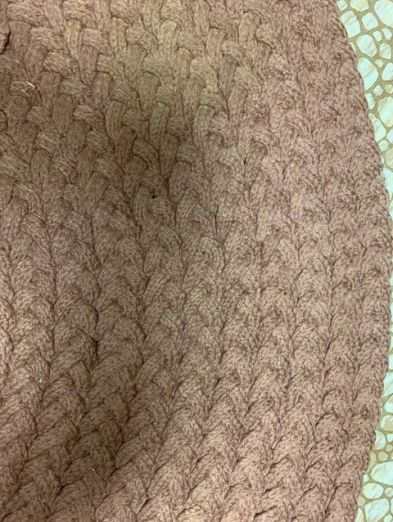

Thanks to Marleen and Robert Frohlich for sharing this.