


I visited Forest Park Museum this spring with Cousins Chris Scar and Elizabeth Wilson, mainly to see their new poster of Dallas County’s Wilson family.


The Wilson children grew up in the town of Dexter during the Depression, were tenant farmers near Minburn before and during WWII, and their parents, Clabe and Leora, bought an acreage in late 1944 on the corner south of Forest Park Museum is now.
We were pleasantly surprised to find a more extensive museum than we’d expected, and enjoyed an extra hour of looking and learning as a bonus to our family history jaunt.


Forest Park Museum and Arboretum was developed in the 1940s by Eugene Hastie, a farmer, author, and local historian.
The museum is now surrounded by an arboretum–with more than 100 kinds of native vegetation, acres of reestablished prairie and wildflowers, as well as hiking paths.
The Forest Park Museum Complex includes Baldwin Hall, Wagner Gallery with an extensive collection of Dallas County history, the Alton School house, the 1860 Grabenhorst log cabin, and the Bill Wagner Scale House. The blacksmith shop display has interactive audio, and there are exhibits about early transportation and railroading, plus a whole lot more.


——-
Oscar Daniels
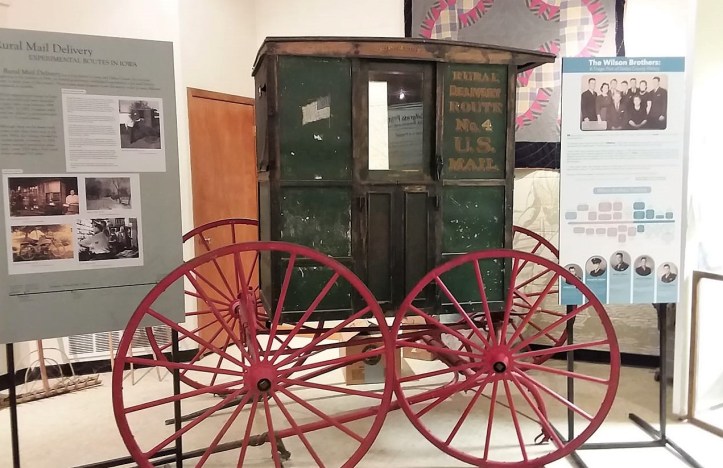
Rural Free Delivery began at Perry in 1900. At one time there were five routes, but by 1937 there were only two. Oscar Daniels and Carl Johnson were the carriers.
Daniels was the one who delivered the telegrams to the Wilson acreage about the loss of their sons. The movies always depict this moment with two men in uniform coming to the door to deliver the telegram, but in rural Iowa, it was delivered by your own mailman.
On August 9, 1945, the Wilsons’ mail had already been delivered, but later that day their mailman, Oscar Daniels, returned and knocked on the door. Clabe and Leora expected confirmation of Danny’s death. They retreated to their bedroom in tears while their daughter Doris went to the door.
She opened the envelope as the words in front of her began to swim.
The telegram didn’t say Danny. It said “Junior.”
But Junior was safe in Texas. I couldn’t be Junior.
In tears, Doris reluctantly showed the unbelievable news to her folks. They wept together. After several minutes, Mr. Daniels knocked on the door. “Is there anything I can do for you folks?”


Hastie’s History of Dallas County by Eugene N. Hastie, printed by Wallace Homestead Company, Des Moines, Iowa, 1938, page 236.

